
Insight
Brand Positioning: Get a good position in customer's mind

(Written by: Lee Kwok Wing / Honorary Advisor of Process Pro Brand Taiwan)
In the face of the global outbreak earlier this year, the masks have become one of the most frequently used items for epidemic prevention. Among all the mask brands, CSD is always in the news for its colorful and impressive products. CSD's brand positioning was originally "health, management, and service to the community", but was rebranded to "health in style". Through the design of the products themselves, as well as the collaboration with singer Xie Jinyan on the song "Turn Masks", and the distribution of thousands of boxes of colorful and fashionable masks for free on New Year's Eve, CSD's brand image has been left vividly in the minds of consumers through the differentiation of its positioning. The brand has left a distinctive brand image in consumers' minds through its differentiated positioning.
According to Kevin Lane Keller, a renowned scholar in brand management, brand positioning is "the activities of the products, services and images offered by a brand that occupy a prominent and important position in the minds of the target group".
Why is brand positioning so important?
With positioning, customers can store the product/service attributes of different brands that are beneficial to them in their minds, and by comparing the differences, it is easier for them to extract their memories and perceive the existence of the brand. In other words, it is not enough for a brand to offer a value proposition that is only beneficial to the customer, but it is also necessary to understand how the brand differs from other competing brands that offer similar values in order to gain a foothold in the customer's mind.

Before developing a brand position, it is important to identify the target market and competitors, determine a set of reference frames, and the best brand association similarities and differences. In other words, we need to understand:
1. who are the target customers
2. who are the main competitors
3. How the brand shares brand associations with competitors; Keller calls this "similarities," meaning shared attributes and benefits. For example, Apple and other companies have introduced smartphones that share similarities in communication and wireless internet access.
4. What differentiates the brand from its competitors; Keller calls this a "point of difference," meaning an attribute or benefit that creates a strong connection between the consumer and the brand, and is positively valued in a way that competitors cannot provide. For example, Apple's iPhone has an intuitively easy-to-use system and a minimalist aesthetic for the product's appearance and interface that separates it from the rest of the industry.
Three Indicators of Brand Positioning Differentiation
Both similarities and differences are essential. With similarities, customers will know which category the brand belongs to and what it is used for; while differences are used to stand out among many brands in the same category. There are three things to keep in mind when choosing a dissimilarity:
1. "Desirability": Relevant and important to consumers.
2. "Realizability": the "feasibility" of a firm's actual ability to provide a product or service and the "communicability" of the firm's ability to persuade consumers of that ability, i.e., the transmission of actual and verifiable evidence of the reasons for the consumer's persuasiveness.
3. "Difference": The target audience finds the difference unique and outstanding.

How do I write a positioning statement?
Summarizing the above, the positioning statement can be written based on the following structure, with further adjustments:
The brand exists for (who?). It is (in what industry, what products/services does it offer?). compared to competing brands because (what kind of tangible and verifiable evidence gives consumers a compelling reason?) What benefits or problems does the brand satisfy? What benefits or problems does the brand satisfy?
As an example, ProAssist's interinfo positioning is stated as follows:
interinfo is a human resource management system with profound experience in system development and implementation. Because interinfo provides a system with multiple modules and flexible expansion, coupled with easy and trustworthy service, it solves the problem of HR information management in enterprises, and also relieves the pressure of timely adjustments in response to changes in regulations.

Related Case:interinfo
Another case is Gastric Reversal, whose localization statement is: Gastric Reflux is a gastric medicine with natural physical and therapeutic ingredients, which exists for the hardcore members of the society who have GERD. It is developed and produced by a renowned pharmaceutical company, Toyo, Taiwan, through a rigorous and precise manufacturing process, and is extracted from pure and natural deep-sea brown algae (kombu), which meets the needs of people who are looking forward to having a gastric medication that is both "fast-acting and effective" and "safe and does not harm the liver and kidneys".
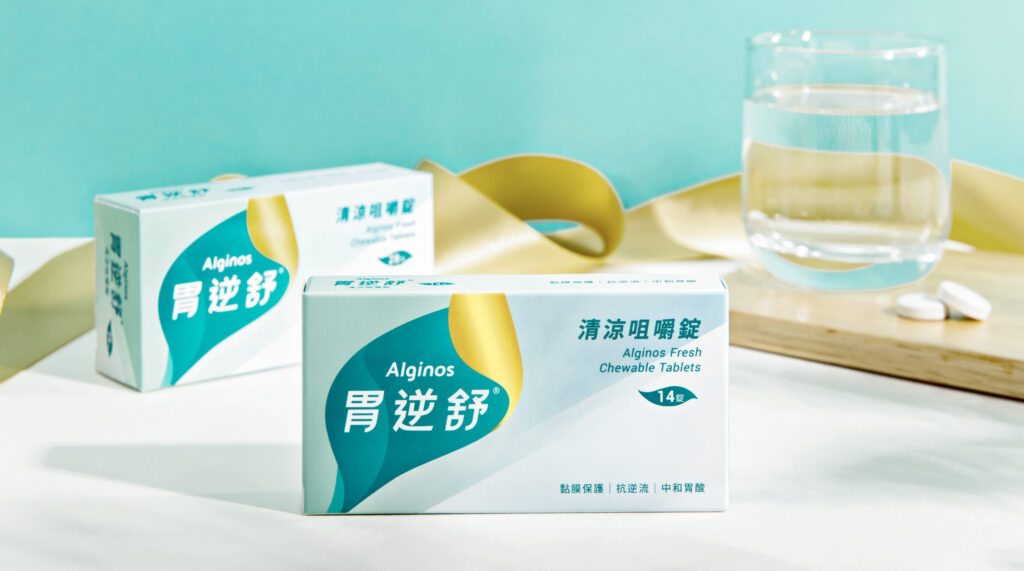
Related Case:Alginos
As a final reminder, the positioning needs to be updated as well.
Enterprises must have regular insights into the consumption motives of the target group for this category, and find out the relevant associations, which can be upgraded from the specific benefits provided by the product attributes to the abstract values or motives. In this way, when competing brands continue to catch up and offer similar attributes or benefits, turning your brand's similarities into category similarities, you can still maintain a differentiated positioning so that your target group will always follow your brand.