
Interview
Brain Magazine Report: 5 Keys to Localized Brand Marketing.
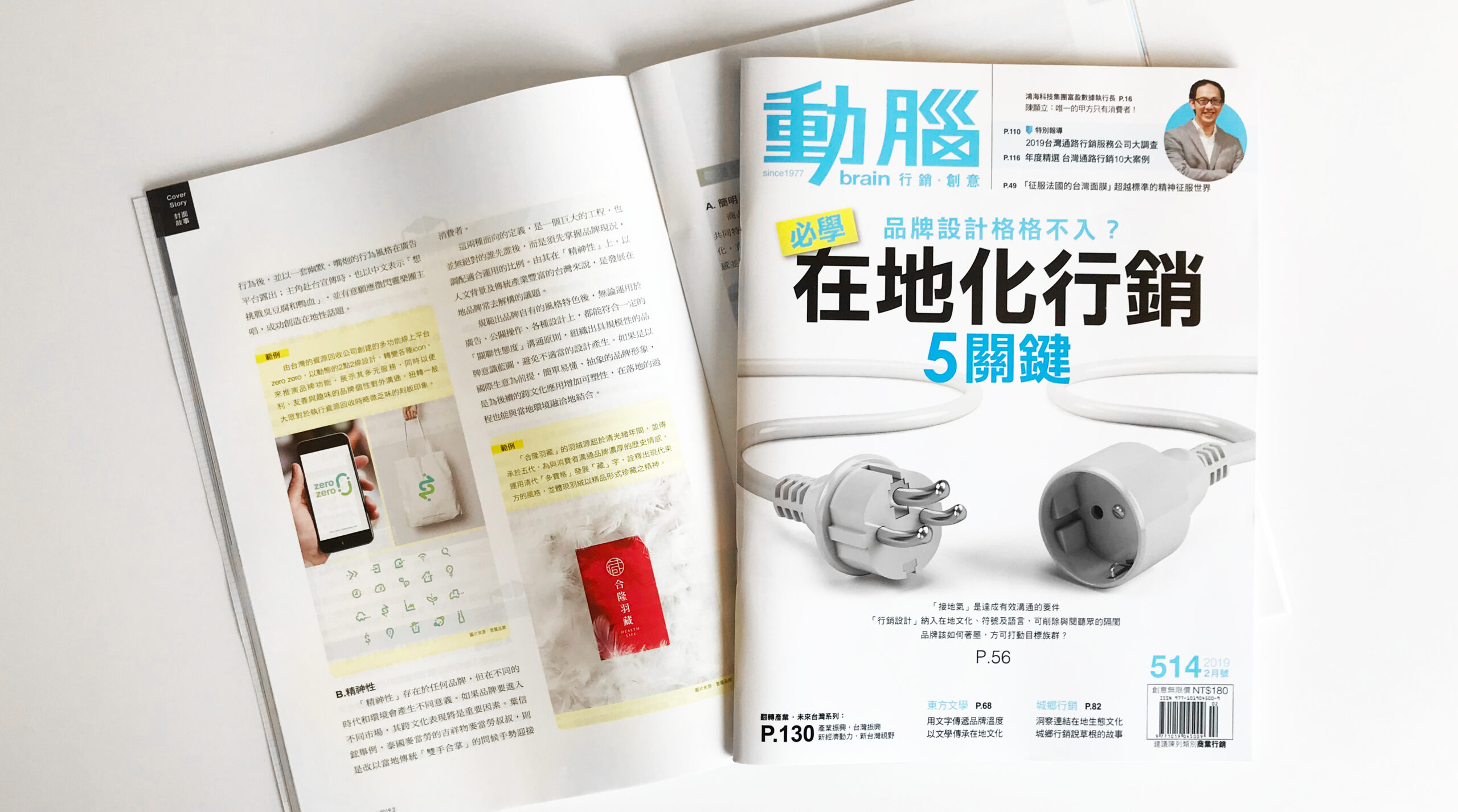
[Reported by Brain Magazine] (Article: Brain Magazine Tzu-Yi Yang)
In addition to adapting to the market climate, brands need to have the empathy to understand different cultures and design marketing activities and products that resonate with local consumers. How to make them "understand, listen and get used to" and then captivate their hearts? There are five key design elements that make brands and markets truly compatible.
Switzerland, a small federal state with a small territory, surrounded by continental powers, with a diverse and complex national composition, and a small giant that has always maintained a spirit of neutrality, developed the International style after the World War and began to take hold globally, emphasizing simplicity, functionality, and rationalization in design.
Even though people all over the world are born in different cultures, they share the same facial features, hands and feet, and their way of perceiving things is not far from each other, so the internationalist design that calls for "simplicity" can be adapted to enter any market.
Lee Kwok Wing, General Manager of the Taipei office of Process, a brand consultancy and design company from Switzerland with offices in China and Taiwan, explains that because the design does not belong to any particular culture or country, its essence can be accepted by all and will not make the brand out of place.
In view of this, the cover story of the February issue of Brainstorm 514 is titled "Brand Design Out of Place? The cover story of the February issue of Brainstorm 514 is titled "5 Keys to Localized Marketing", which explores the 5 keys of brand image and marketing design that can make a good impression on various markets.
Global Localization: Brand Globalization, Communication Localization
Many Taiwan SMEs want to get rid of the traditional OEM and develop their own brands in the international market, but the owners often wonder: "Do brands need to be localized?". In this regard, Process believes that a good combination is to "globalize the brand, but localize the marketing communication".
For example, Taiwan's local enterprises, specializing in the production of pumps, Fang Sheng Electrical PRORIL, emphasizes the spirituality of the brand in a simple form, and in the process of expanding the market in Europe, the United States and Southeast Asia, the use of abstract shapes to establish unique characteristics, which can be felt in various environmental markets with different imagery, and has become an international style that can be grounded.
Process Pro Branding reminds that the version of the branding strategy developed from the ground up will still be an extension and optimization of the original branding, which can echo each other, rather than a completely new development, contradiction or offsetting effect.
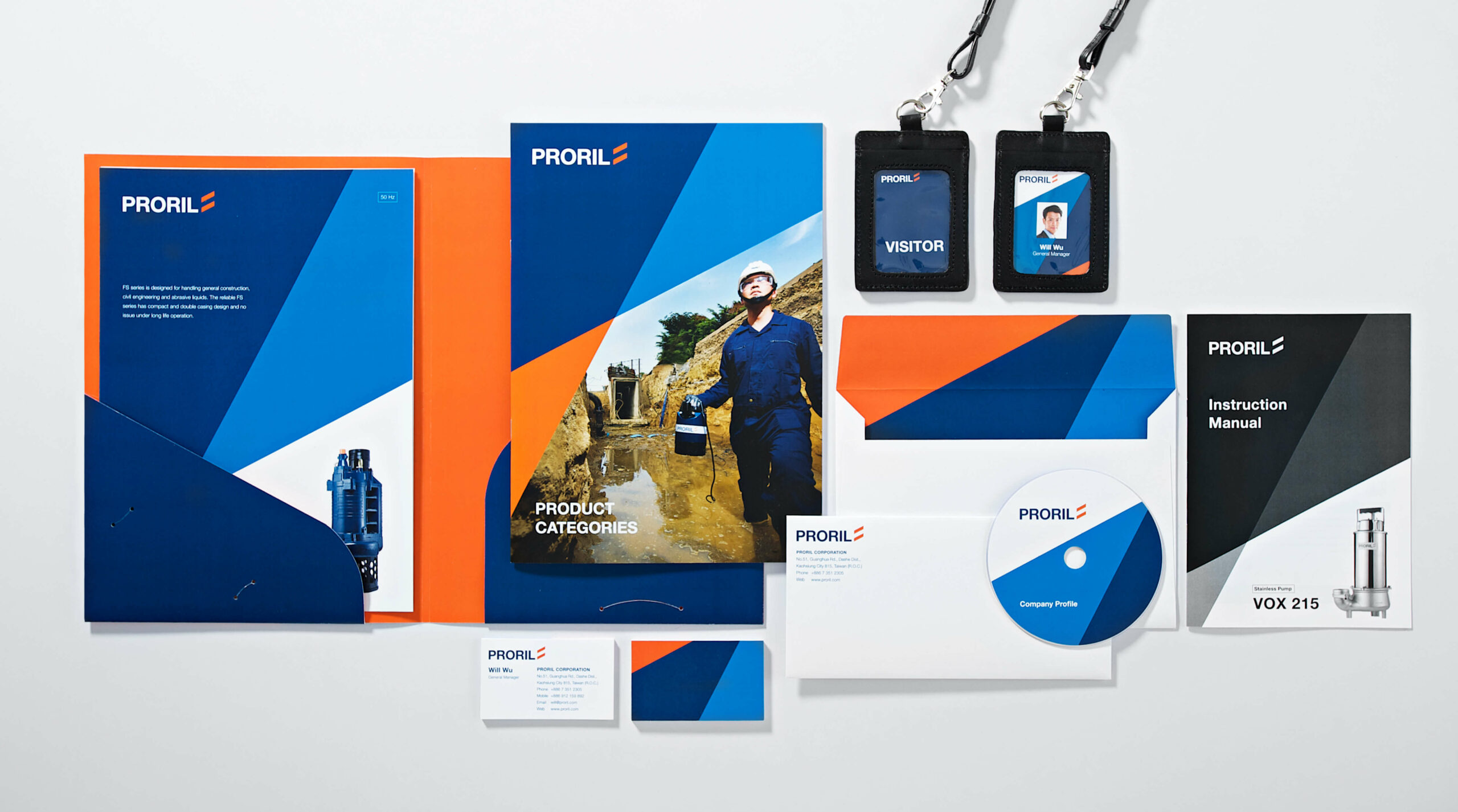
PRORIL's international design PRORIL's design, the public can not clearly point out where this brand comes from? But everyone has their own interpretation, which can be adapted to different markets.
Key 1: 4 hurdles for market-ready visas
1. Political statutes
For some brands to enter the Muslim market, they have to go through a "halal certification" process. "Halal certification is derived from Shariah law, which requires believers' food or products that come into contact with their bodies to comply with Islamic teachings to avoid contamination with unclean substances. In the case of food products, for example, the plant regulations at the source, the slaughtering of meat, and the packaging and transportation process all need to comply with the Shariah.
2. Scientific and technological developments
For brands that rely heavily on network bandwidth and mobile devices, it is important to have adequate network infrastructure in the target market.
3. Language culture
A product name or marketing copy may be interpreted differently in different markets. A common crisis is not consulting native speakers before naming a brand, which can lead to negative associations with the local audience and lead to losses. For example, the popular Chevrolet model "Nova" in the U.S., which means "Nova of the Universe" in English, did not sell as well as expected in Spanish-speaking markets such as Mexico because "Nova" means "not going" in Spanish.
This is why Swiss wine merchant SCHULER, for example, uses the brand name "HENLE" in its communication with China to avoid the association of "losing" in the English pronunciation.
4. Collective consciousness/social atmosphere
Does the market embrace globalism or does it favor nationalism? Free and open or traditional conservative values? What are the definitions of humor and discrimination? Examples include H&M's "Coolest Monkey in the Jungle" children's clothing controversy and Dolce & Gabbana's recent "insulting" ads.
Key 2: Brand Design 2 Orientation
An attitude of relevance is essential to what customers are interested in and what role brands can play in that. The challenge is to find the key to resonance between the various stratums. The "attitude of relevance" is defined in the pre-strategy to create a strong connection between the various touch points of the brand. In order to conform to the "relevance" of the appropriate identity, and in order to avoid mistakes during the design process, the design is firstly split into "functional" and "spiritual" as the basis for anchoring:
Key 2: Brand Design 2 Orientation
An attitude of relevance is essential to what customers are interested in and what role brands can play in that. The challenge is to find the key to resonance between the various stratums. The "attitude of relevance" is defined in the pre-strategy to create a strong connection between the various touch points of the brand. In order to conform to the "relevance" of the appropriate identity, and in order to avoid mistakes during the design process, the design is firstly split into "functional" and "spiritual" as the basis for anchoring:
1. Functional: As a simple adjective describes it, it is a projection of habit.
Design for "functional" needs is not culturally bound, but rather a business model unique to a brand's industry that has evolved into a culture of communication with the market. As reflected in the visuals, it is a logical system necessary in design to create a connection with the audience through effective and precise communication.
Take the movie "Deadpool" as an example, after defining the character and behavior of the protagonist, a set of humorous, tongue-in-cheek behavioral style was revealed on the advertising platform. When the protagonist went to Taiwan for promotion, he also expressed his desire to challenge stinky tofu and duck blood in Chinese and was willing to apply for the lead singer of The Shining, which has successfully created a local topic of sexuality.
As an example, zero zero, a multi-functional online platform created by a Taiwan-based recycling company, uses a dynamic 2-point-2-line design and transforms various icons to deduce the brand's functions and showcase its diverse services. At the same time, it uses convenience, friendliness, and fun to communicate the brand's personality, reversing the public's stereotype of recycling as being boring.

2. Spirituality: It does not have a specific form, but is the form generated by the brand's deep corporate culture or conceptual awareness.
"Spirituality" exists in any brand, but it has different meanings in different times and environments. If a brand wants to enter different markets, its cross-cultural performance is an important factor. EPILEDS YEH cites the example of Ronald McDonald, the mascot of McDonald's Thailand, who has switched to the traditional greeting gesture of "hands together" to greet consumers.
The definition of these two aspects is a huge project, and there is no absolute who comes first and who comes last. Rather, it is necessary to grasp the current situation of the brand and deploy the appropriate proportion, and in terms of "spirituality", in terms of the humanistic background and the richness of traditional industries in Taiwan, it is an issue that is often deconstructed in the development of local brands.
After standardizing the brand's own style characteristics, no matter applying it to advertising, public relations operations, or various designs, it can conform to the principle of communication of "relevance attitude", organize a large-scale brand awareness blueprint, and avoid inappropriate designs. If international business is the premise, a simple, easy-to-understand, abstract brand image is to increase the plasticity for subsequent cross-cultural application, and can be harmoniously integrated with the local environment in the process of landing.

The "Hap Long Feather Collection" originated during the Guangxu period of the Qing Dynasty and has been passed down through the five generations. In order to communicate the brand's strong historical sentiment to consumers, the brand utilizes the Qing Dynasty's Doppelganger to interpret the "modern oriental" style, which embodies the spirit of collecting down in the form of fine products.
Key 3: 3 checkpoints for brand marketing:
1. Briefing
In a market environment where there are many products and information, how to find the differences among the common features? We can make the brand strategy precise and sharp, directly cut into the core of insights, and clearly make the target audience feel and remember.
2. Unanimously
In the past, brands could be positioned differently in different countries due to geographical, language and technological constraints. However, globalization has shortened the distance between people and it has become important to maintain brand consistency to increase trust among customers.
3. Sustainability
Nowadays, there is a huge amount of information, so it is easy to enhance brand recognition by developing a set of tone and maintaining management and communication. According to Lee, some marketers may change new agencies to create new advertising campaigns for the sake of freshness, thus interrupting the brand identity they have previously created.
Rebranding Case: Naming and Packaging of Dream Chicken
"Brand naming" has always been one of the most important challenges in the local language. For example, the Swiss wine merchant SCHULER entered China and communicated its brand name as "HENLE" to avoid the association of "losing" in English pronunciation.
Chicken essence brand "Dream Chicken" from Taiwan's Fool's Farm originally used the word "Foolish" as one of its English names, but it attracted negative associations from overseas. Therefore, the English name of the brand was changed to "primona" as the new identifying image, and it was accompanied by high-quality, simple American-style packaging design, which made the product more refined than before; in addition, Dream Chicken has not entered the halal market, and it has also set up a new factory that complies with the Islamic regulations.
"Is mainstream European and American design not suitable for the New Southbound or Asian markets?" In fact, this is evident in this case. It is suggested that companies should return to the value proposition of the brand, whether there is a "high correlation" between the target customers, and if customers have a preference for European and American design styles (e.g. Singapore, Japan), or if the brand is highly correlated with the country's industries, then it can be adopted to add points to the brand. In short, it is still important to assess whether the brand and the customer can find the highest common denominator.
*想知道更多案例分享,請見動腦雜誌2019年2月號*
https://www.brain.com.tw/news/articlecontent?ID=47433