
Insight
Mastering the criteria of evergreen brands and inheriting a century-old enterprise.
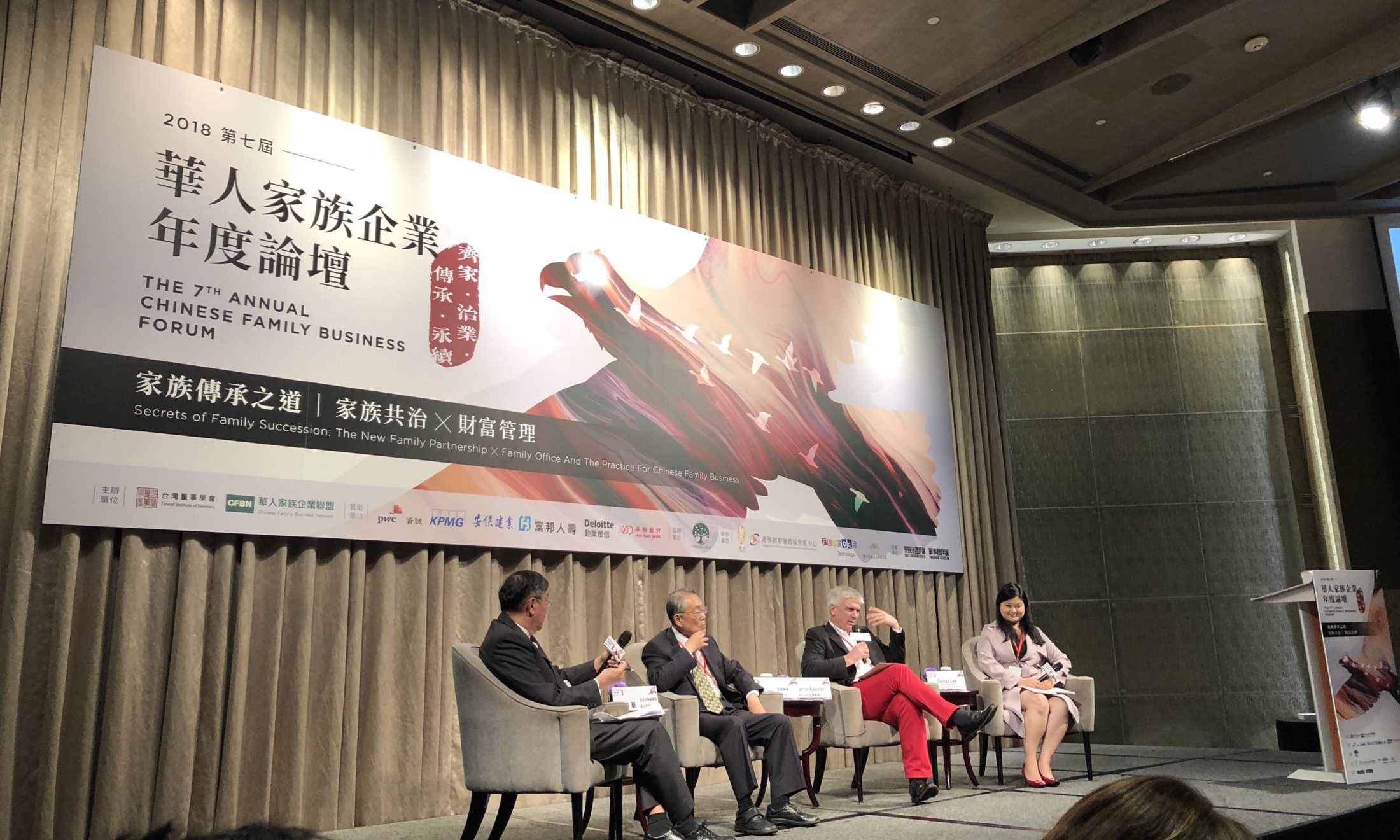
Organized by the Taiwan Institute of Directors and the Chinese Family Business Alliance, the 7th Chinese Family Business Forum was held on November 21, 2018. In addition to the release of the 7th annual "Chinese Family Key Report," the Forum also featured multinational experts, such as Shih Chun-Jung, Founder of Acer Group, Prof. Toshio Goto from Japan, Dr. Hiu-Lu Lee from McKinsey & Company, and Martin Kessler, Founder of Pro Brands Group, to discuss the importance of family unification, governance, inheritance, and sustainable management. Experts gathered together to explore the ways of family unification, business management, inheritance, and sustainable governance.
In the "Summit Dialogue: Family Co-Governance," hosted by Professor Ruihua Li of the School of Business at National Chengchi University, Mr. Shih, Mr. Li Xiaolu, and Mr. Or Yanding spoke with Mr. Shih. Mr. Shih pointed out right at the beginning that, to him, ownership and management are separate because the high-tech industry is changing so rapidly that it is not enough time to pass on to the founder's next generation, so it is inevitable to pass on to a professional manager rather than to a son. The founder's task is to effectively plan the layout of the succession, trust the talents, and continue the determination and passion for change.
Taking his own three-generation career history as an example, he is not surprised to see the trend of "de-familialization" mentioned in the "Key Report on Chinese Families", as he worked in his father's advertising agency when he was young, left to start his own brand consulting group, and now his daughter is working in the Zurich office. Compared to the past, when people cared most about their work and industries changed slowly, and generations might work in the same jobs and join the same unions, the world continues to change, and the next generation faces different challenges, and the focus of their lives is no longer just on their work, but also on healthy and balanced lifestyles, and more free-spirited values. Therefore, he doesn't want to impose his own intentions on his daughters, and he hopes that they will be able to enjoy their work, and that they will be able to take over the reins. Succession is not inevitable, but a result of natural development.
Mr. Sze added that the most important job of a founder is to pass on the intangible spiritual culture, but how should it be done? He opined that
In addition to a clear statement, there must be continuous communication and a mechanism to ensure implementation and internalization in actual work behaviors.
For example, he proposed an industrial ecosystem with the spirit of "The Way of the King," shared value creation, and sustainable management, which is realized through individual business units, from small to large. He encouraged everyone that change is not an easy task, but with Prof. Toshio Goto's idea of "altruism" and continuous improvement, we will be able to achieve a hundred-year enterprise.
Ko observed that Taiwan is the Switzerland of Asia, and its geography, resources, human resources and civilization all make him feel like he is back home in Asia, so Taiwanese people can be more confident, whether it's OEM or brand, Taiwanese people have created many miracles and should be more proud of themselves; however, he is also very proud of the fact that Taiwan is the Switzerland of Asia, and that it is the only country in the world where Taiwanese people can be proud of themselves.
Self-confidence requires a clear understanding of one's own blind spots, judging what can be done well by oneself and what can be outsourced or abandoned, just like building a brand strategy, to be clear about one's own strengths and amplify them, rather than blindly seeking extra-industrial sources of finance and losing the core competencies and fundamentals of the brand.
Lee Swee Wah also said that having self-confidence and trusting others is the only way to succeed in succession and to choose the right professional manager.
Li Xiaolu pointed out that the challenge of a family business is to maintain the entrepreneurial spirit of the successor after the succession. In addition, it is also necessary to find out who the successor is in Hong Kong, and it is suggested that the successor can be found from different related people. She suggests that it is not only limited to the "succession" of the next generation by blood relationship, but it is also necessary to "train" different leaders, including family members, relatives and managers, and identify candidates by rotating them through different departments, and at the same time, train a group of leadership team for the future successors. Lee reminded that it is more difficult to develop generalists than specialists, so long-term planning is necessary.
Echoing Shi Zhenrong's idea of "the Way of the King" and Prof. Goto Toshio's idea of "altruism," Ke Yanding argues that
Enterprises that have a corporate social responsibility (CSR) mindset to build a sustainable brand are more likely to be able to operate sustainably and become a 100-year enterprise.
For example, the Swiss insurance company has built hundreds of health trails for the public to enhance their fitness and coexist with the company. Lastly, he emphasized that when choosing a CSR project or area of investment, it is important to review the brand's foundational strategies, including mission, vision, positioning, core value propositions, brand personality, and guiding principles, in order to maintain the brand's simplicity, consistency, and continuity, and to create a long-lasting brand that can be passed down through the generations of family-owned businesses.