
Insight
Business succession starts with branding.

(Text / Lee Kwok Wing / Honorary Advisor, Process Pro Brand Taiwan)
Does your company have any of the following?
"Since I started the company, I have been looking forward to the next generation of successors, but it seems that the team is not yet ready, and I still have to do it myself...".
"The previous generation claimed that they would authorize the younger generation to do the work, but in the end, they are still the ones who say what to do, and the company can't do anything to create a new atmosphere...".
According to statistics, the number of small and medium-sized enterprises (SMEs) in Taiwan reaches more than 1.5 million, accounting for about 98% of all enterprises. Based on Pro's experience over the years, it is true that a high percentage of SMEs that have been established for 30 to 50 years, or even more than 100 years, come to Pro at the opportune time when the previous generation is handing the baton over to the next generation in anticipation of promoting the company's advancement through brand reengineering. In the course of project execution, it is most common to observe that the previous generation wants to pass on the legacy, but the next generation is not ready, or the previous generation wants to make gradual changes, but the next generation wants to make drastic changes. In other words, there is a lack of consistency between generations, and due to the busyness of day-to-day operations, it is not possible to communicate effectively outside the existing framework, which leads to a lot of difficulties.
Passing on the entrepreneurial spirit of the previous generation through the brand.
In fact, rebranding, commonly known as "branding", can be one of the most powerful management strategies for corporate succession, because corporations can wave their brand as a flag to call on their talents and resources in production, marketing, human resources, development, and finance to push forward in the same direction, thus generating a comprehensive effect on internal and external management and communication.
In order to do this, we must first compile and inventory the glory of the company along the way, and from the origins of its founding, the iterative development of its products, the expansion of its service territory, and the awards and recognitions it has received over the years from industry, government, and academia, we must distill out the entrepreneurial spirit, the key technologies, and the profit-making model, which are the unique, tangible, and intangible assets of the company.
Next, through the brand reengineering project, the company's intergenerational and inter-departmental consensus, tell a consistent story externally, continue to show a clear brand identity, and confidently demonstrate the corporate heritage that can withstand the test of time, so that a good corporate image, and keep pace with the times to accumulate brand assets.
WALRUS pumps, for example, was founded more than 55 years ago, through two generations of inheritance, has been the leading brand of water pumps in Taiwan, in order to move towards the vision of becoming a world-renowned brand, the succession team initiated a brand reengineering program to amplify the beauty of the brand on the basis of the original good, not only won awards in Taiwan, including the Taiwan Excellence Award, but also won the Good Design in Japan, the Korean K-Design, and the World Branding Awards (World Branding Awards), and other international awards recognized. In addition, the company has also won international awards such as Good Design (Japan), K-Design (Korea), and World Branding Awards.
Case reading: WALRUS Oi pumps
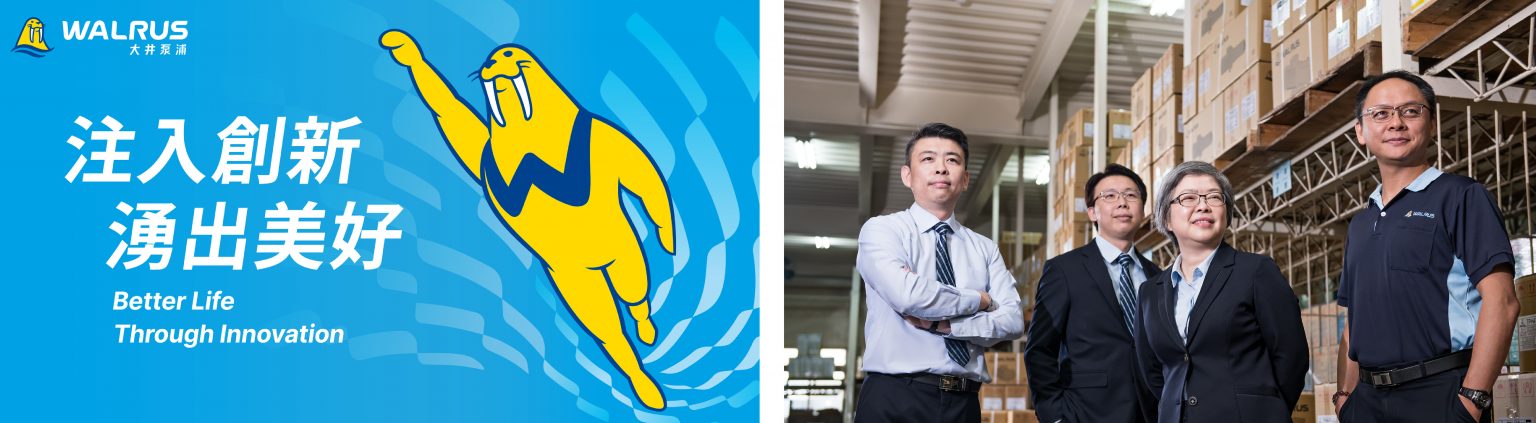
(WALRUS Oi Pump's second-generation succession team launched a rebranding program with the vision of becoming a world-renowned brand)
What are the trade-offs in intergenerational transmission so that the assets do not become a burden?
It is suggested that enterprises can think about the following two points
1. To last for a long time:
What is the core purpose of your business? Who is it for, what products and services do you provide to satisfy your customers, and what would the world lose without your business?
2. New and new day by day:
By examining which of our existing products and services still meet the future needs of our customers, we can continue to scale up and even develop a second growth curve that rides on the well-established foundations of our predecessors.
For example, the He Long Woolen Factory, founded during the Guangxu period of the Qing Dynasty, has been passed down through five generations and is one of the oldest, largest and most widely spread professional down manufacturers in Asia. In addition to continuing to expand the down material business to five continents, the current Chairman, Mr. Chen Yen-Cheng, has further established the "Ho-Lung Feather Collection" private brand, combining online and physical channels, extending the provision of bedding and accessory products and housekeeping services, and innovating the business model so that the whole enterprise can continue to excel in the next hundred years.
Read more: Interview with Yen-Cheng Chen, Chairman of Hoplite: Good things should be made available to the Taiwanese themselves
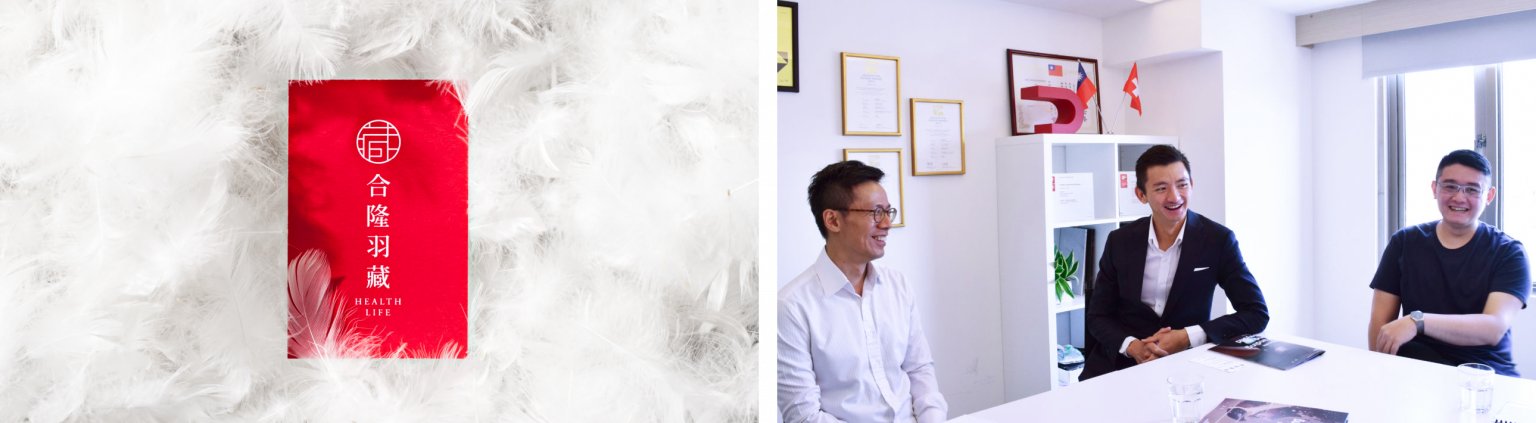
(Mr. Yen-Cheng Chen (middle), Chairman of HLF, Mr. Rong Li (left), Honorary Advisor of Process Pro, and Mr. EPILEDS YEH (right), Creative Director of Process Pro, chatting about their successors and giving them a lot of advice at Process Pro's Taipei office)
You may ask: Does intergenerational transmission necessarily mean transformation?
According to Pro's observation, Taiwan enterprises have created economic miracles in the last century through trading, R&D, production, etc. Since 2003, the government has promoted the Branding Taiwan private labeling program, which has assisted enterprises in developing brand strategies and images for more than 20 years and gradually enabled the previous generation to have brand awareness, however, OEM design and manufacturing is still the main source of profit, so the proportion of resources invested in private labeling is limited. However, OEM design and manufacturing is still the main source of profit, so the proportion of resources invested in private labeling is limited. In the future, in the face of the above mentioned dividends are no longer available and the domestic market is too small, the development of world-oriented private labels has become an opportunity for the next generation to transform, and further planning and deployment of marketing and promotion, channel layout, and service experience are needed.
In particular, the post-epidemic era from 2020 onwards has had a huge impact on all aspects of life, accelerating the adoption of digital applications and focusing on sustainability issues, and how to incorporate them into business operations, which has become an essential issue for a smooth transition.
The company is a good example of this, as it has been developing products based on the highest principle of "Green Chemistry", which has overturned the stereotypical image of chemical factories, and has not only supplied chemical raw materials to internationally renowned brands, but has also created a number of its own brands. 2021 onwards, the company recognizes that global sustainability policies are imperative, and has therefore continued to adjust its body structure to ensure that the Green Chemistry brand will remain unshaken.
Read more: JHI Takes Stock of Company's Capabilities, Upgrades Technology, and Implements Green Enterprise Goals
Brand consultants are with you on the road to corporate heritage.
By now, you should have recognized and wanted to take action, but you may be facing challenges both vertically and horizontally:
1. Vertical:
The inherent power gap between the previous generation and the next generation of operators, and even the conflicting roles of family blood relations, lead to an inability to detach themselves from monitoring the business.
2. Level:
The benefits of silos across departments, working in silos, lead to value propositions filled with breakpoints in meeting the customer experience journey.
In view of this, brand consultants, with the objective role of a third party, professional methodology, and rich experience in cross-industry and cross-company, help corporate teams to co-create not only a stylish brand design and style, but also the process of gathering the invisible and colorless common beliefs, and ultimately shaping the everlasting brand that is recognized by all stakeholders.
Read more: Why Co-Create Brands?