
Interview
Interview with Pro Brand Founder and CEO: Building Your Brand Tree

[EMBA Magazine Interview
Recently, Process was interviewed by EMBA World Manager's Digest on how to build a successful brand. Martin Kessler, the founder of Process, believes that "the way to build a brand is the same whether you are a big company or a small business". Markus Gut, CEO of Process, also pointed out, "A brand is not just a logo, it's a tree, the root is the analysis, the trunk is the content, and the crown is the customer experience, if any one of these elements is missing, what will become of the brand? What are the principles that companies need to pay attention to when building a brand?
Whether you're a large company or a small business, the approach to building a brand is really the same.
Founder Martin Kessler
Founder Martin Kessler says that even though small businesses have fewer resources, regardless of size, companies need to do their research well when building a brand, to clarify the message the brand is trying to convey, and to know their raison d'être. If a company doesn't know the answers to these questions, it won't survive.
Markus Gut, the new CEO of ProcessPro, said that the process of building a brand is like planting a tree, where the roots represent analysis, the trunk is the content, and the canopy is the customer experience. In nature, there are big trees and small trees, but size doesn't mean winning or losing.
"Your company may be a great potted plant, but potted plants have roots, trunks and fruits, just like those big trees." he said. He said.
ProcessPro is a Swiss marketing and branding consultancy with offices in Taiwan and China. The founder, Mr. Yen-Ding Ko, was formerly the brand director of Swissair and a juror for international design competitions such as the IF. He has also served as the mayor of Zumikon, a city in Switzerland that encourages the integration of private enterprise with the government, and has extensive experience in politics and business. Gert, who just took over as CEO of Process in 2018, has worked as CCO of major advertising agencies such as Publicis and Y&R in the past.
They said that many companies mistakenly believe that once the logo is designed, the brand is complete, but this is only the beginning. In addition to visual design, brands need content and customer experience, especially in today's customer-driven world, where brand content has become very important. You have to show your brand all year round in order for customers to remember you," says Gert. It's the only way customers will remember you," says Gert:
No one is going to wait for you now, a company's brand must always be present and part of the customer's life.
Mr. Ko and Mr. Gerdt recently visited Taiwan and were interviewed by this magazine. The following is a summary of the interview:
The environment is changing rapidly, and marketing is evolving even faster. According to your observation, what are the most important marketing trends in the next one or two years?
Gert: One of the trends is that E-commerce is turning into A-commerce. E-commerce is when people use the Internet to buy products, and A-commerce is when people use augmented reality (AR) to shop. When a customer uses AR on an e-commerce platform, the emotional experience they get can be almost identical to the one they would get if they were actually in a store.
Yanding Ke: Augmented Reality is growing very fast and will rapidly move into all areas in the next few years. For example, the iPhone X has augmented reality built in now, and it's going to be more and more prevalent in the next generation.
However, while everyone is pursuing technology, there is also a crisis. The danger is that people are thinking about big data or new technologies and gradually losing sight of basic brand values and branding strategies, which is very dangerous.
Ge: The root of a brand is very important because technology is always changing rapidly, and it only takes two or three years for there to be another major breakthrough in technology. Companies need to pay attention to the roots of their brands, otherwise everything will be floating around without any support.
Compared to the past, companies have many more points of contact with their customers. However, now the control is not in the hands of the company, but back in the hands of the customer. What challenges does this bring to the organization?
Ge: Content has become very important. In addition, companies must present their brands to customers all year round. No one is waiting for you, the company has to be in the customer's life all the time and be a part of their life.
Ke: The 360-degree marketing that we used to talk about is actually a rather passive approach. Companies thought that because they provided all kinds of media channels, customers would make their own decisions. That doesn't work anymore. Now you have to go to the customer. That's why Gert says we have to be there for the customer all the time. For example, a customer might be at the bank at 2 p.m. using their cell phone to process an online transaction. For everyone, 24/7 touch points are the reality.
Ge: Today, companies must ask: "What is interesting to customers?" In the past, they would say, "I'm a brand, I have great products, and customers must buy from me." But now, companies should be asking themselves, "What role can my brand play in the lives of my customers? How important is my brand to the customer? and "What message does my brand convey? and "What are the strengths that make customers choose me over my competitors?"
For example, Migros is Switzerland's largest retailer with stores all over the country. Migros has a private label called Migusto. When customers go into a retail store, they can find beans, coffee, and food like milk, but these are just company products. So Migros created the cooking brand Migusto to provide customers with inspiration on how to use their ingredients.
For example, when a customer sees rice, they can use Migsto's app to get more information about what dishes they can make with rice for dinner today. Next, the recipe might tell the customer that maybe rice would be good with shrimp, and that's when the product, rice, connects the customer to the shrimp.
Migsto is in the customer's life because it helps people. The brand doesn't just indicate the price, it lets the customer know how to use the product. For example, if the consumer is a family, it shows them how to spend quality leisure time with their family; if the consumer is a couple, it shows them how to prepare a meal for two; or if the consumer is just one person, they can still eat well.
The brand isn't just selling products, it's helping customers experience a better life.
Migsto offers its customers information about cooking, food and wine all year round. Above all, everyone in Switzerland who mentions Migstol thinks of it as a brand for good living and good food.
Building a successful brand is not easy. In your experience, what are some of the pitfalls that companies tend to fall into when building a brand?
Ge: Many companies think that with a new logo, it's all over. This is the most common pitfall. To build a brand, first a company has to study the market, decide on brand values, and then build everything around those values. Brand identity is only a small part of the process.
A brand is like a tree (pictured below); a tree needs strong roots to grow well. So, where the roots are, a company must first conduct research and then develop a brand strategy from the results of that research. Next, the tree grows a trunk, which has to be strong and sturdy in order to support many things, and the trunk represents the content.
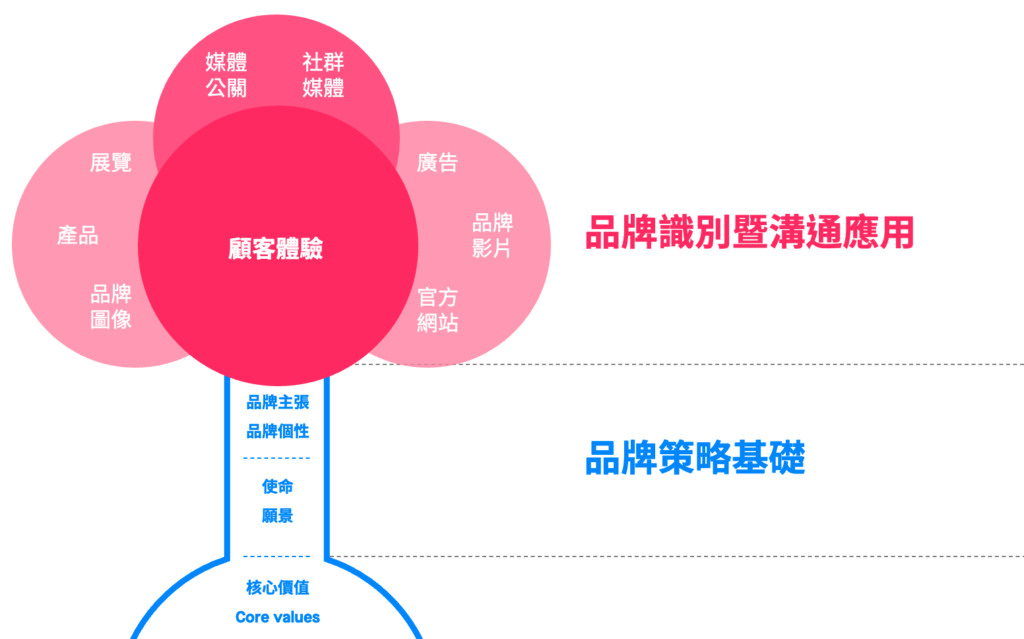
A brand is nothing without content.
In fact, once a company has done its research and defined its brand values, it may be able to make a brand identity or logo, but without content, the company can't move forward to the next step because it won't be able to deliver the experience.
The next step up is the most important part of the tree: the fruit, which is the customer experience of the brand at each touch point. The world is changing rapidly, and every year something new comes along. Perhaps the next step for a company is digital marketing, and social marketing is another fruit, and gradually the brand grows and grows bigger and bigger. When a company does the right analysis, develops a brand strategy, fills in the content, and finally presents it on the Internet, what you have is not just a trademark, you are a brand with content.
In-house brand experience
In addition, it is important for internal employees to know what the company's brand values are. What can I do to be proud to be part of the company? Or, new employees must know the symbolism of the company's brand.Employee engagement is critical to branding, so executives should educate them and provide an internal brand experience. This is actually the same as an external marketing campaign.
Cole: For example, we've helped a client that's a big company. In a big company, it's always difficult to get everyone involved. So when it hires new people, they have to take some tests related to the company's brand. In addition, the company has an app that chronicles the company's history, which is a learning tool to help new employees understand the company. Finally, there are some quizzes to test the learning status of the employees. In this way, employees learn about the company's brand values, what behaviors to exhibit, and what the company's goals are.
Ge: The second common pitfall is that many organizations forget to go back and validate their brand strategy and values. They think that because the brand name hasn't changed, the brand strategy doesn't need to be updated.
But businesses change, technology changes, new competitors emerge, and company products evolve. Therefore, companies should review their brand strategy and values every year, or every other year.
Cole: Another pitfall is that certain companies are always compared to businesses in different industries and of different sizes. A lot of people will compare their company to Coca-Cola or Nike. It doesn't make sense. Coca-Cola or Nike can invest billions of dollars in their brands, but a company in Taichung might only have a budget of two million dollars. It's like comparing a runner to a skateboarder. Even if you start training now, you won't necessarily be able to run faster than a skateboarder ten years from now.
Therefore, if a company wants to make a comparison, it should consider the realities of the situation and not create unnecessary blowback for itself. If you run a coffee shop, you don't need to compare yourself to Starbucks, but you should compare yourself to your competitors in the neighborhood. Observe what products and services they offer and focus on your target customers.
Small Businesses Should Have Brands Too
Does it take a lot of resources to build a brand tree? If an SME has limited resources, how should it build a brand tree?
Kirk: Whether it's a large company or a small business, the approach to building a brand tree is actually the same; they all need to do their research properly, choose which strategy to utilize, clarify the message the brand is trying to convey, know their reason for being, and what they need to do now. If a company doesn't know the answers to these questions, it won't survive, and it has nothing to do with the size of the company.
GR: Just like nature, some trees are smaller and some are bigger. Your company may be a great potted plant, but potted plants have roots, trunks and fruits, just like those big trees.
Cole: For companies, branding is an investment, not just in the budget given to the advertising agency, but in your own time as well. It's worth noting that what a company decides to invest in will give life to the brand.
As mentioned before, the visual identity, logo, colors, and fonts of a brand are just the tip of the iceberg, and there is still a lot of work to be done by a company.
In fact, bringing a brand to life is a much more complex challenge than building a brand, and a company has to work consistently to make it happen. In addition, positioning is very important. As companies work through the analysis phase, you need to find your niche in the market.
You don't want to position your company's brand in a place where you already have ten competitors. You want a position that will stand for a long time.
If a company is building a brand tree, what advice would you give them?
Cole: Companies should understand that building a brand is the responsibility of senior executives; it's not a task that can be delegated. Executives can't say, "I'm not interested in branding, so I'm going to let my team handle it full time." Company leaders must be involved and lead the process.
Branding cannot be successful without the support of a senior executive. The executive can delegate the "job" of branding to someone else, but he or she must be responsible for driving the program and acting as the voice of the process. The company needs to let all employees know that the program is coming from the top down.This is because branding is related to the DNA of an organization, and the shaping of that DNA is absolutely the job of the company's leaders.
Source: EMBA Magazine, Issue 383, "Building Your Brand Tree".
Welcome to read more EMBA Magazine