Insight
Even TSMC is doing it! Of course B2B can be branded!
(Article reprinted from Digital Times, original articleClick here)
B2B business can also be a brand. However, it is necessary to think clearly about the stakeholders of communication, the key contents of communication, and also to establish a value proposition that customers can relate to, and even influence the internal team, and be prepared to face the future together with customers.
A brand is the sum of the existing impressions of a company's performance in the minds of customers and the general public.
In other words, from the potential customers have a need, start searching for relevant products and services, decided to order to buy, delivery process, actual use, until the final generation of good reviews or customer complaints on the enterprise or surrounding friends and relatives to share, all this process of contact with the enterprise's products and services information, will be accumulated in the customer's cognitive and feelings of the enterprise's various memories, and extracted at the appropriate time, become the so-called brand image, and enterprises actively design various actions to communicate with customers is "branding". The so-called brand image, and enterprises in the process of actively designing a variety of actions to communicate with customers is "branding".
The above process is called "Customer Experience Journey", customers have specific tasks to achieve in different stages to solve pain points or increase benefits, and at a certain point of contact to generate a critical moment, so that he / she generated to the next stage of the momentum; enterprises must understand the needs of customers, and in the journey to give the corresponding solutions, and this requires mobilizing the different departments of the enterprise to collaborate, in order to allow customers to successfully complete the journey and continue the cycle of business transactions with the enterprise. This requires mobilizing different departments within the company to work together in order for the customer to complete the journey and continue the cycle of business transactions with the company.
Therefore, B2B companies, regardless of whether they are big B or small B, regardless of whether the customers they face are big B or small B, of course, they can make brands.
B2B Before making a brand, you have to think clearly about who you want to communicate with.
When we shift our focus from the abovementioned cross-departmental cooperation within the enterprise to the outside, we need to consider different stakeholders, that is, internal and external groups or individuals who have influence on or are affected by the enterprise's operation. In the case of a B2B enterprise, these can be roughly categorized into primary and extended stakeholders: the former includes existing customers, potential customers, partners, and employees, while the latter includes end-consumers, the media, the government, and non-profit organizations, etc. Depending on the industrial environment in which the enterprise is situated, it is important to assess how much resources are to be invested in paying attention to and responding to the needs of each type of stakeholder.
If you look at the "Corporate Core Values and Business Philosophy" page on TSMC's official website, you can see that the target audience for communication is not only customers, but also stakeholders such as peers, suppliers, employees, shareholders, and the general public.
(Source: ITRI)
For example, we have assisted a company engaged in the manufacture and sale of large-scale tooling machines, the implementation of the brand diagnosis case, in the internal interviews and factory visits, learned that the enterprise specializes in aerospace, automobile and motorcycle parts and other industries, planning, design, manufacturing, assembly, installation to the commissioning of a consistent operation of the processing and production line, the customer is spread throughout the international community, the customer said in the interviews with the enterprise's customers in India, the customer said that at first there is a need for the product. First through the marketing campaign to learn about the existence of the product, and contact the business window to understand the characteristics of the product, but there are a lot of professional questions in the process, but also very much need to talk to the R & D engineers, after all, a cost of tens of millions of dollars of tools machine, you need to complete the decision to order sufficient information, so look forward to the transaction process of the enterprise can have a good English proficiency of the business with a professional knowledge of the engineers, in the first instance, can be quickly Therefore, we expect the company to have good English skills and engineers with professional knowledge in the transaction process, so that they can respond quickly at the first time and increase the trust on the brand, thus accelerating the willingness to deal.
Compared to B2C, what does B2B need to communicate to the general public?
B2B branded products and services are more specialized in a particular industry or field than B2C, requiring a higher level of knowledge and experience. In addition, the products or services provided by B2B brands may be part of the entire industrial value chain, and once the performance or quality is not as expected, such as when the manufacturing industry encounters mechanical failures or poor physical properties of raw materials, it will result in negative chain reactions such as downtime losses, delayed deliveries, and penalties for breach of contract.
Therefore.B2B brands most often communicate about R&D and innovation capabilities, stable production capacity, and a committed partnership.As for price, although it is also important, from Pro's experience in interviewing B2B customers, people in different positions in the customer side of the team care about different things: e.g., material developers care about innovation, production QA people care about stability, and purchasing people care about cost. In other words, price is not the only thing that matters, and when a company continues to optimize the combination of the above, it will accumulate a positive corporate reputation.
If you look closely at TSMC, the four core values of communication for the stakeholders mentioned above, including integrity, commitment, innovation and customer trust, are also the focus of B2B brand communication.
(Image source: shutterstock)
With a positive corporate reputation, we can stabilize the trust relationship of partners in the industrial cluster, including upstream raw material suppliers and downstream distributors, so that our products and services can reach customers through a wider range of channels, and we can continue to build a distinctive brand image to widen the gap with our competitors, so that we don't have to resort to lowering our prices in order to gain customers' favor.
What are some of the special points to look for in a B2B brand?
B2B brands, which seem to be rational buyers and sellers, need to jump out of the red sea of low-price competition, so that enterprises can switch from price thinking to value thinking, and then they can establish the "emotional" differentiated value of the brand to stand out. After all, the subject of communication for B2B brands is still "people", and touching people's emotions is the key to ultimately affecting their purchasing behavior. Therefore, for B2B brands, if they can strengthen the emotional connection between the brand and customers, the chances of winning in the industry will be greatly improved, and a differentiated brand advantage will be established, which will in turn inject the impetus for sales growth.
Here are three key points for you to realize your B2B brand's emotional potential:
I. Resonance: Establishing a value proposition that resonates with customers
Apart from functional benefits, is it possible to go further and satisfy other needs of customers above functionality? Such as emotional, self-expression or social benefits? By identifying value propositions that resonate with customers, customers will be able to empathize with the brand and build a sense of identity.
For example, a very famous public cloud service AWS, in the early years of the promotion in Taiwan, because of the insight of enterprise customers worried about the cloud may produce data leakage concerns, so through customer testimonials, such as: even the United States NASA involved in national security and confidentiality is also used to ease the worries; another foreign enterprises within the IT staff worried about the work to be replaced, AWS advocate cloud services can help enterprises digital transformation, so that IT staff to engage in more valuable work to become a talent to keep pace with the times, and customers resonate. AWS advocates that cloud services can help enterprises transform digitally, so that IT staff can engage in more valuable work, become up-to-date talents, and resonate with customers.
Second, the power of experience: brand stereotypes, not only to customers, but also to influence the staff team, and supply partners.
Combining the brand's unique style and through the unique five senses experience, such as: visual identification system and communication application; auditory image and audio-visual creation; in terms of touch, more use of the special material and texture of the product; in terms of taste, the use of the characteristics of food and drink, to strengthen sensory identification; in terms of smell, the shape of the environment of the exhibition or conference scent, so that customers can be more vividly feel the characteristics of the brand conveyed, link and accumulate a series of imaginations of the brand, greatly increasing the brand share of the customer. This allows customers to vividly feel the brand's characteristics, connecting and accumulating a series of imaginations of the brand, and greatly enhancing customers' brand share.

(Source: UNIQLO)
Wizardry: Multi-oriented services and modular solutions to help customers solve future problems.
Based on the diversified needs of customers in the market, brands should start from the beginning, understand the behavioral patterns of end-customers, and integrate their own technologies and services from a long-term development perspective to provide systematic modular solutions to lead customers steadily forward, and to become a good business partner that can be trusted with peace of mind.
ANKO Food Machinery from Taiwan, marketing in more than 110 countries around the world, has more than 40 years of experience in producing more than 300 kinds of ethnic food products, and can provide customers with highly integrated services such as food production line planning, recipe consulting and R&D, complete pre-sales and after-sales services, and teaching machines, as well as advice on the latest food market trends, a full range of solutions to become an indispensable teammate of the food industry in the expansion of the global gourmet market. Our comprehensive solutions have become an indispensable teammate of the food industry in expanding the global gourmet market.
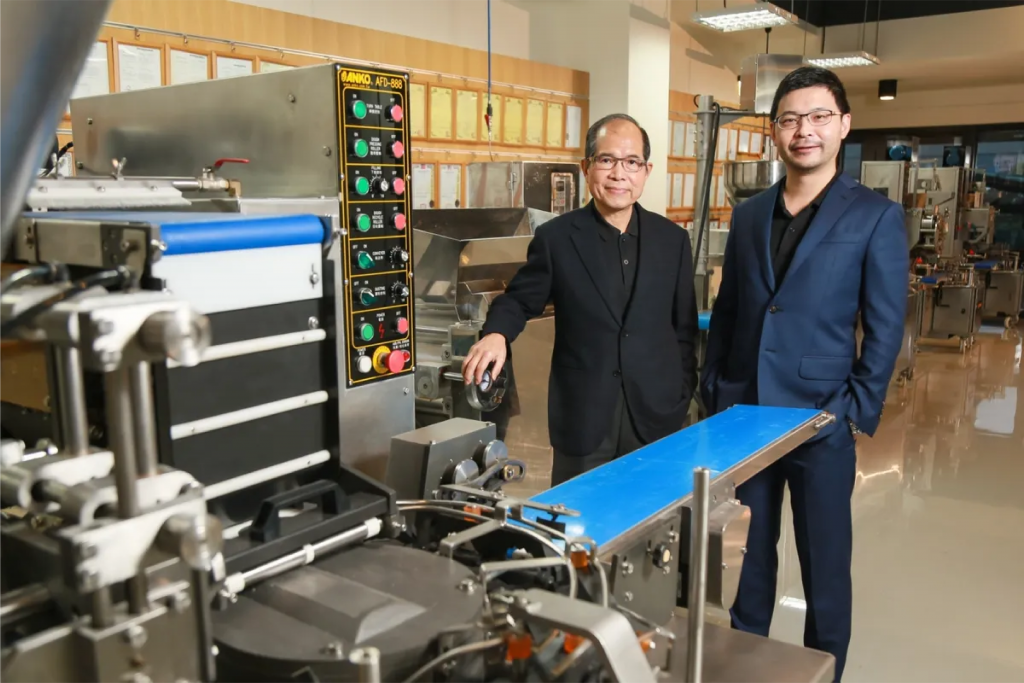
(Source: Photography by He Daxin)
If you look at TSMC, they continue to do the same: "Resonance" in its business philosophy mentions that its business is specialized in integrated circuit manufacturing services, and from the beginning, it has positioned its customers as partners and never competes with them, so as to give them peace of mind; "Experience" puts forward employer branding aspirations for potential talents and employees, including "creating a challenging and fun working environment" and "establishing an open management model" to increase the imagination and expectations of working at TSMC; and finally, "Wizardry" emphasizes the importance of establishing a base in Taiwan as well as in major markets around the world, and to meet the needs of a diversified international development culture in recruiting talents, regardless of international development culture. Finally, in terms of "Mentorship", TSMC emphasizes the need to establish bases in major markets around the world and to meet the cultural demands of international diversification, as well as the importance of recruiting talented people regardless of nationality, in order to provide customers with a complete deployment of the company.
At this point, readers should know that B2B enterprises also need to do branding, and know how to do a good job of branding.