
Interview
Facing the ESG Wave, a starter for brand realization.

(Abstract Record: Qi-Wen Hong / Process Assistant Consultant, Pro Brand Taiwan)
As ESG investment continues to grow, so does the importance companies and investors place on ESG. Companies that meet ESG criteria often attract more investment, which in turn increases the value of their stocks and bonds.
Therefore, ESG should be considered as a key element in the rebranding process of SMEs, and a comprehensive inventory should be conducted to review the implementation of ESG principles. Actively practicing ESG principles not only helps to build a good brand image, but also attracts more investment and capital, thus realizing long-term sustainable growth.
ESG, or Environmental, Social and Corporate Governance, is an integrated investment and corporate management framework designed to assess the environmental, social and governance performance of companies.
Environmental: The full name is ”Environmental issues” concerned with a company's carbon footprint, energy use and natural resource management.
Social: The full name is ”Social issues” which focuses on the relationship and contribution of a company to society with its employees, community and other stakeholders.
Corporate Governance: Focuses on the internal organizational structure, transparency and accountability of the company.
To ride the wave of ESG, Process Pro Brands invites existing employees to join the ESG program.Ms. Mei-Huei Lin, Advisor of AUO Sustainability Department, AUOIn addition, she shared her rich experience in the field of sustainable ESG with her colleagues and brought more new insights to the Pro team.

(Photo of Ms. Mihui with ProCare colleagues: Ms. Mihui Lin is in the center with the white jacket.)
ESG's past and present
Ms. Mihui guided us into the world of ESG by telling us a story: in 1989, the Exxon crude oil tanker suffered the oil spill of the century, causing an ecological catastrophe. In the 30 years since then, oil spills have continued to occur. This led to the creation of the Global Reporting Initiative (GRI), a voluntary disclosure framework with 44 industry sectors and more than 100 numerical indicators of environmental, social and corporate governance.
Back in 2008, when the financial crisis swept the world, reports showed that companies with excellent ESG performance had little impact. With the United Nations' advocacy of the 17 Sustainable Development Goals (SDGs), International Financial Reporting Standards (IFRS), and increasing climate change, many companies believed internally that they could ride out the storm with ESG. As a result, ESG has become an obvious subject, and in 2023, Taiwan's Financial Supervisory Commission (FSC) will make it mandatory for listed companies with more than $2 billion to publish a Sustainability Report or ESG Report in June of each year.
(Note: Companies with higher ESG scores indicate that they are more robust and can achieve financial transparency and a low-risk operating model. Investors' confidence in this type of enterprise is naturally higher and they are less likely to withdraw their capital, so the enterprise is subject to lower investment risks compared to enterprises without ESG scores).
In addition, the National Development Commission (NDC) also announced the "Taiwan 2050 Net Zero Emission Pathway and Strategy General Description" in March 2022, which will achieve the following four major goals with the help of technological research and development as well as the climate law system, namely, safe energy, strengthened industries, sustainable living and resilient society.
Secure Energy: Increase the ratio of self-produced energy and reduce the impact of international energy prices on Taiwan's energy market.
Strengthening the industry: Meeting the global industry's demand for green common chain and accelerating industrial upgrading
Sustainable Living: Changing People's Lifestyles and Putting Green Awareness into Practice
A resilient society: to mobilize private investment, create more job opportunities, promote economic development and improve social institutions.
In the "Taiwan 2050 Net Zero Emission Pathway and Strategy General Explanation", there are 10 industries in 3 major departments as the primary transformation targets, namely the manufacturing department, the commercial department and the energy department, and these 10 industries are the key to achieving net zero carbon emissions.

Facing the ESG Wave, a starting point for brand realization
What can enterprises do then? First of all, it is necessary to start from the inside out, from top to bottom.
Internal: 3 phases of tasks to be introduced in a sequential manner
Stage 1: Knowledge Base Building➔ Employees understand the company's commitment to sustainability, initiate systematic learning, strengthen skills, and implement actions.
Establishing a correct knowledge base is the key to understanding and applying ESG principles. Specifically, we can start from the oath of the staff meeting, daily communication to strengthen the concept, or the office environment to promote and encourage action.
Stage 2: Integrate ESG into core values and brand foundation➔ Concretize sustainability commitments through daily actions.
By incorporating ESG into a brand's core values, a company can build a more honest, responsible and sustainable brand image, thus laying a solid foundation for long-term success. In the brand building process, ESG focuses on issues such as overall strategy, collaboration and crisis management. Factors such as core business values, long-term impact and stakeholders are taken into consideration to enhance the effectiveness of corporate communication and to strengthen the stability and sustainability of the brand image.
Stage 3: Issues and Practices➔ Sharing Encouragement of Concrete Results and Establishing a Two-Way Proposal Pipeline。
ESG covers a wide range of issues, such as corporate pollution, Global Reporting Initiative (GRI), self-regulated investment, government regulations, and UN initiatives, all of which show the role of ESG in important issues. Therefore, companies can set up internal sustainability task forces, track ESG progress and results on a regular basis, recognize departments with outstanding ESG results, and share results quarterly, or set up internal ESG proposal platforms to encourage the provision of good ESG ideas and provide budgets or incentives to implement ESG step by step.
External: Demonstration of results and annual production of the Corporate Sustainability Report.
Corporate Sustainability Report (ESG Report)It is also known as the annual ESG results report of a company. Ms. Mihui mentioned that publishing a sustainability report every year is a very big project. The iterative updating of the framework, cross-departmental data collection and data management are all time-consuming and labor-intensive projects.
Businesses can do this byCarbon Footprint Verification Inventory of direct/indirect carbon emissions from various segments, including purchasing, production, sales, supply, transportation, and employee commuting..., and major issues analysis to start examining ourselves and take the first step towards industrial transformation and net-zero goals.
One of the top priorities of theMateriality AnalysisDefinition of Critical Issues Definition of materiality: "TheAny key information that can influence an investor's decision."Companies must take stock of their own materiality issues and make policies accordingly. For example, the critical issue for an e-commerce company is information security, but for a food company, it may be fine. Therefore, the focus of each company's external communication will be different.
Process Pro Branding helped Sinyi Realty build its employer brand, and the big issues wereTalent training and development, labor-employer relationsetc.
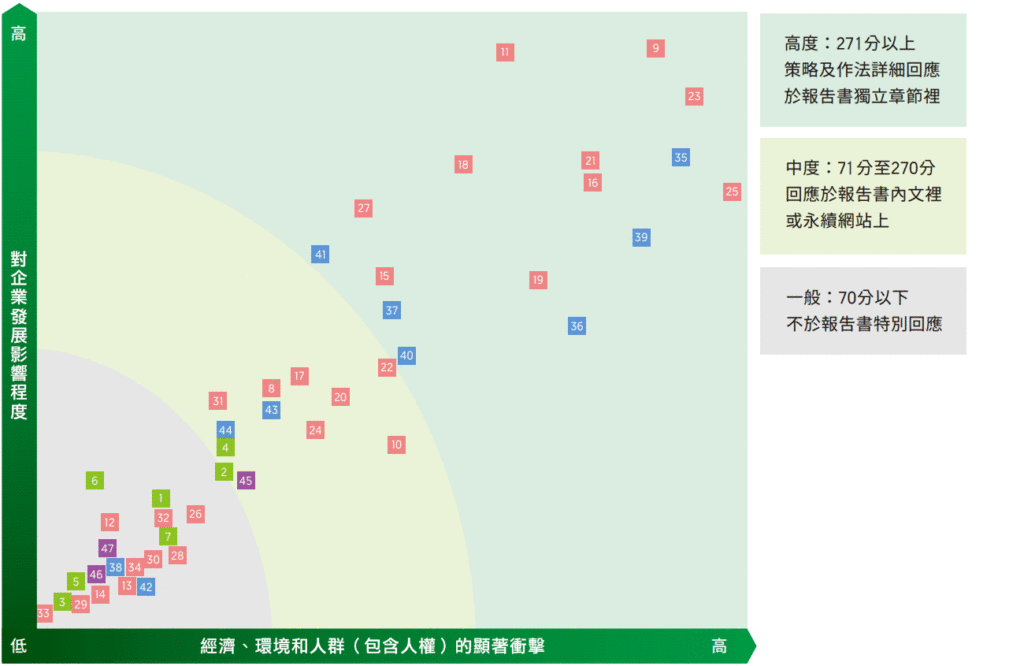
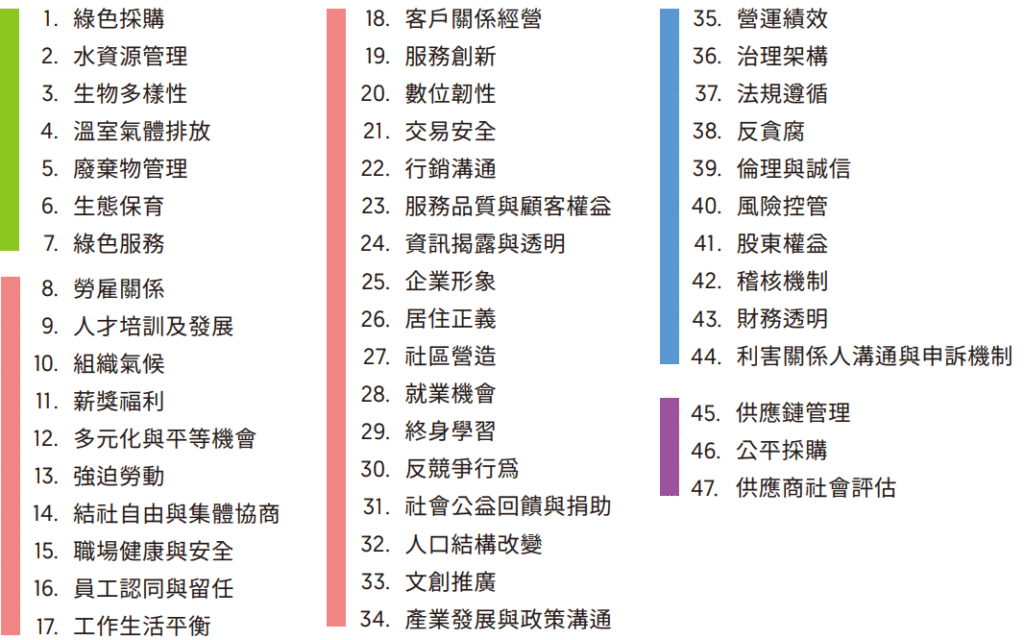
(Reliance Housing Materiality Matrix, source: Reliance Sustainability)
Click here to read the case study ➔ Faithful Housing: Treating people well and putting "people" at the center of our faith.
The analysis of material issues ensures the interests of stakeholders who are closely related to the company. It is not only for the purpose of corporate sustainability report, but also crucial for the operation of the company.
Ms. Mihui reminds us that a company's pursuit of ESG cannot be limited to the annual presentation of its corporate sustainability report. Instead, it needs to keep up with the times.Continuously learning and adapting ESG knowledge from different industries to ensure your ESG knowledge is at the forefront of the fieldOnly in this way can we realize the effective combination of top-down decision-making and implementation and inject more possibilities for sustainable development. Only in this way can we realize the effective combination of top-down decision-making and implementation, and inject more power and possibilities into the sustainable development of enterprises.
Those who asked Ms. Mie about ESG: Common ESG Questions for Businesses

After listening to Mr. Perfect Hui's wonderful sharing, colleagues also raised some questions and exchanged with him. The following excerpts are for enterprises' reference:
Q:If a company sets ESG targets but finds it difficult to achieve them after taking stock of the actual situation, can it apply for a temporary change of the targets? Or how should I respond to it?
A: Yes, adjustments can be made at any time without the need to apply. When setting ESG objectives, companies need to take stock of their core strengths, stakeholder expectations, etc., and make adjustments in line with the overall trend. If a company exaggerates its ESG targets, it must provide reasonable explanations because the report is published annually and the data is cumulative (e.g. business strategy, water, electricity, carbon emissions, turnover rate, ratio of male to female directors...).
Click here to read the viewpoint article ➔ Huang Jindun: Inventorying Company Capabilities and Implementing ESG Objectives
Q: Now that the ESG trend is in full bloom, will there be companies that only use ESG as a marketing label?
A: Yes, trend marketing has always existed. Nowadays, ESG is a popular trend, and there are many enterprises that are in a hurry to invest in it. As long as a company is committed to ESG, it should be accommodating. However, companies are like human beings in that they have different personalities, specialties, ambitions, and sense of morality. However, companies are like people, with differences in personality, expertise, ambition, and moral sense. There is also a difference between outwardly visible and inwardly recessive leadership qualities. In the long run, it is still possible to review the results of ESG practices. However, companies must be reminded that ESG is all about long term impact. If it is used as a marketing label, it may gain instant popularity or instant sales, but it is not sustainable.
Q: What should companies do so that they will not be perceived as bleaching green?
A: Enterprises can prevent consumer concerns about greenwashing through ESG disclosure, such as publicizing carbon footprints, third-party certification, publishing methodologies, announcing mid-term targets, transparency and accountability. In essence, this is a form of misrepresentation. The EU has recently adopted a draft Green Claim Directive on January 17, 2024 to ensure that environmental claims made within the EU are credible, comparable and verifiable, in order to protect consumers from being deceived or misled by "greenwashing" companies or products. In particular, the draft Green Claims Directive does not only target companies in the EU, but also includes foreign companies that transmit environmental claims for their companies or products to consumers in the EU market.Therefore, Taiwanese companies exporting their products to the EU should also pay more attention.
It is important to realize that ESG represents not just a short-lived trend, but a major change that can have a long-term impact.
ESG investing is no longer just a matter of style, but is recognized as one of the most important factors in a company's success.
In this environment, enterprises should incorporate ESG into their rebranding projects to ensure that their business operations comply with the criteria for sustainable development, take stock of and integrate ESG factors by carefully reviewing environmental, social and corporate governance aspects, and build a strong brand by clarifying the value of ESG as an action, and should even write ESG into their corporate DNA, which will help to penetrate ESG concepts throughout the corporate culture and operations and establish a sustainable brand image, thus enhancing brand recognition and trust, and accumulating brand benefits in the long run. Only by writing ESG into the corporate DNA can we help to integrate ESG concepts into the entire corporate culture and operation, establish a sustainable brand image, respond to the ever-changing market demands, gain a competitive edge, enhance brand recognition and trust, and accumulate brand benefits in the long run.
[SpeakingTeacher: Amy Lin]
Ms. Mie likes to interact with young people and is always grateful for the new perspectives and ideas they bring to her. She is always grateful for the new perspectives and ideas that they bring to her, from small things in life to world events, from personal growth to social responsibility. In such interactions, she is often touched by the wisdom and inspiration of young people, and inspired by their courage and determination.
Current Position Consultant, AUO Sustainability Dept.
He has served as a consultant for CSRone Sustainability Think Tank, media liaison for Academia Sinica, lecturer for the Department of Journalism and Advertising at Chinese Culture University, lecturer for the Department of Communication at Ming Chuan University, guest editor-in-chief of Living Water Fortnightly, editor-in-chief of the Overseas Chinese Affairs Commission's Haihua Magazine, and editor of the United Daily News.
